When I joined the Operations Management Unit (OMU) of MINUSMA’s Field Technology Section, project information was dispersed across teams, personal drives, inboxes and hundreds of Excel files. Management was responsible for a large, geographically dispersed ICT portfolio, but did not have a reliable single view of its status.
I was brought in as Business Analyst to help turn that fragmented information into a functioning management system. Over the following two and a half years, I consolidated the portfolio, established a structured reporting and collaboration environment, and introduced a regular project-monitoring cycle covering 92 ICT projects, more than $100M in annual budget, 10 ICT sub-units and 12 regional locations.
When MINUSMA subsequently entered its closure phase, that operational discipline became relevant to a very different challenge: coordinating the decommissioning of 270+ ICT services and thousands of deployed assets across the mission.
The real lesson is that effective project monitoring directly enhances staff productivity, making complex organizational transitions achievable.
The Challenge
A dispersed ICT portfolio without a reliable, centralized data source
When I arrived in July 2021, project information was spread across three OMU units and nine sub-units, with hundreds of Excel files containing overlapping, outdated or inconsistent information.
For the OMU senior management, this created a practical governance problem.
There was plenty of data, but no dependable way to answer basic management questions quickly:
- What was the actual status of each project?
- Which activities were delayed?
- What resources or decisions were required?
- How was expenditure evolving?
- Which projects needed management attention?
The portfolio itself was highly dispersed. Projects ranged from regional infrastructure deployments and telecommunications work to country-wide network initiatives.
Beneath the project level, the underlying ICT infrastructure represented an estimated 7,000 to 8,000+ individual systems and devices — communications equipment, network infrastructure, telecommunications systems and specialised technical assets, deployed across the capital and the twelve regions. Monitoring implementation progress at that scale, and translating it into information management could act on, was itself a core part of the role.
The problem was therefore not simply administrative. Management needed a reliable operational picture of a complex ICT portfolio spread across Mali.
Two years later, the context became even more demanding. Following MINUSMA’s closure mandate, the Field Technology Section had to coordinate the shutdown of ICT services and infrastructure across 12 regional locations, under a fixed timeline and challenging security conditions.
The original governance problem and the closure problem had a common requirement: clear information, clear ownership and operational project monitoring.
A six-month deadline for a decade-old mission
In June 2023, Mali’s transitional government requested MINUSMA’s immediate withdrawal. The UN Security Council responded by terminating the mission’s mandate effective 30 June, with a fixed deadline of 31 December 2023 for the full withdrawal of personnel, equipment and infrastructure. A mission built over more than a decade had six months to close.
For the Field Technology Section, this compressed an already large task into a fraction of the time it would normally require. The 7,000–8,000+ ICT systems and devices deployed across the capital and 12 regions, networks, telecommunications infrastructure, surveillance and specialised security systems among them, all had to be inventoried, categorised, decommissioned or transferred, and formally signed off within the same six-month window as every other section of the mission. There was no scope to extend individual site timelines: each region’s closure date was fixed by the wider drawdown schedule, and slippage in one location had knock-on consequences for the whole plan.
Operating under that constraint became the norm rather than the exception. Every decommissioning plan, every asset write-off and every sign-off had to be produced against a deadline that could not move, in a mission whose infrastructure had never been built with a six-month teardown in mind.
The solution
Turning data into an operational management system
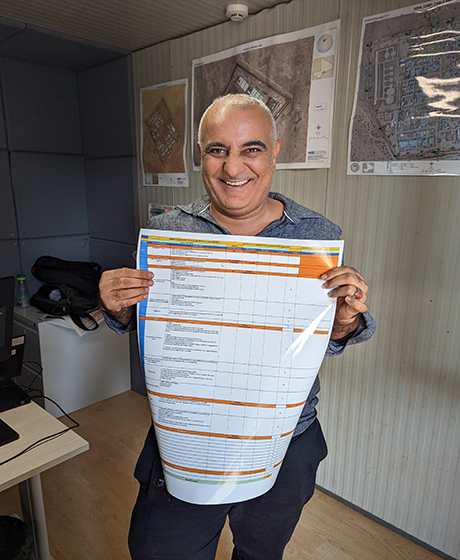
Once the underlying data was reliable, the next challenge was to make it useful for managing the portfolio. I structured and tracked more than 820 individual tasks, spanning major ICT projects, standing operational work across the units, and, later, closure-related activities and established a regular reporting and follow-up process that brought together project status, budget information, implementation progress and operational issues across the different ICT units and regions. The monitoring system was not designed simply to create dashboards. Its purpose was to support decisions.
I became a central reference point for project status, consolidating information from project managers and technical teams and making it available to senior management. The same information structure also supported the unit’s biannual Results-Based Budgeting (RBB) cycles, including the cross-checking of project, expenditure and acquisition-demand information.
In parallel, I supported broader technology-management initiatives, including the roadmap for migrating web application servers and databases to Azure Enterprise Cloud, and participated in the mission’s ERP rollout. This expanded the role from project reporting into broader business analysis and operational coordination.
Building the Information Backbone for Mission-Wide ICT Closure
When MINUSMA received its closure mandate, the Field Technology Section had to safely decommission over 270 ICT services and thousands of deployed IT assets across every regional camp, without losing accountability for a single item. I acted as the Technology Department’s point of contact for the whole closure: designing the reporting structures used to collect and consolidate closure data from all 12 regions, authoring 26 decommissioning and contingency plans, designing a RACI matrix to make ownership unambiguous, processing end-of-life write-offs directly into the ERP system, and coordinating sign-off of every decommissioned service by clients and senior managers. I coordinated with counterparts in Italy, New York and regional offices across Africa to align the shutdown with wider UN logistics.
The results
Centralized ICT Portfolio Governance
Established a common monitoring framework covering 92 IT projects and $100M+ in annual budget, tracked weekly across 10 sub-units and 12 regions.
SharePoint Collaboration Platform, ~320 Users
Built the mission’s shared project-documentation and collaboration hub, used by clients across the country.
Mission-Wide ICT Decommissioning Support
Tracked and coordinated 270+ ICT service decommissioning activities and thousands of deployed assets across every region, each one signed off by clients and senior managers.
26 Decommissioning & Contingency Plans Authored
A contingency plan for every region and system category, written to hold up under real deadlines and an active security situation.
Budget and Portfolio Coordination
Supported biannual RBB budgeting cycles, reconciling project, expenditure and acquisition-demand information with financial and operational stakeholders mission-wide.
Reliable Management Reference Point
Established a consolidated view of project status that let senior managers see portfolio progress without relying on fragmented individual updates.
What the Field taught me
The data is only the beginning
The key takeaway is that effective management doesn’t come from a dashboard only, it comes from a disciplined chain: reliable data, clear ownership, consistent reporting, rigorous tracking, and evidence-based decisive action.
Technology simply enables that operating model: Closure is an operational process, not an inventory exercise. Mission closure also demonstrated that an asset list cannot be treated independently from the people and operations still depend on the infrastructure.
For example, removing network access points too early could disrupt personnel still working at a location. Packing materials and protective equipment had to arrive before dismantling activities began. Asset movements had to be sequenced around security and transport constraints. The operational reality therefore had to inform the closure plan.
Preparation reduces pressure at the end
When assets are categorized early, responsibilities are clear, and disposal processes are ready, closure becomes significantly more manageable. The principle extends beyond peacekeeping: the more complex the transition, the earlier accountability and traceability must be embedded into the process.
This experience reinforced an approach I continue to apply in complex assignments:
When organisations are struggling with fragmented information, the answer is rarely another report. The real value lies in creating the operating system that makes reliable reporting, coordination and decision-making possible.